There are many verbs that start with the letter C. These verbs help us speak and write in English. We use them in our daily lives. Some verbs describe physical actions. Others describe thoughts, feelings, and activities.
In this article, you will learn common verbs that start with C. You will also find their simple meanings and easy example sentences.
How to Learn Verbs That Start with C
Learning new verbs is easy when you practice regularly. Follow these simple tips.
- Read the list: Read five to ten verbs every day.
- Learn the meanings: Understand what each verb means.
- Write sentences: Use each new verb in a short sentence.
- Speak aloud: Say the sentences clearly.
- Practice verb forms: Learn the present and past forms.
- Revise often: Read the words again to remember them.
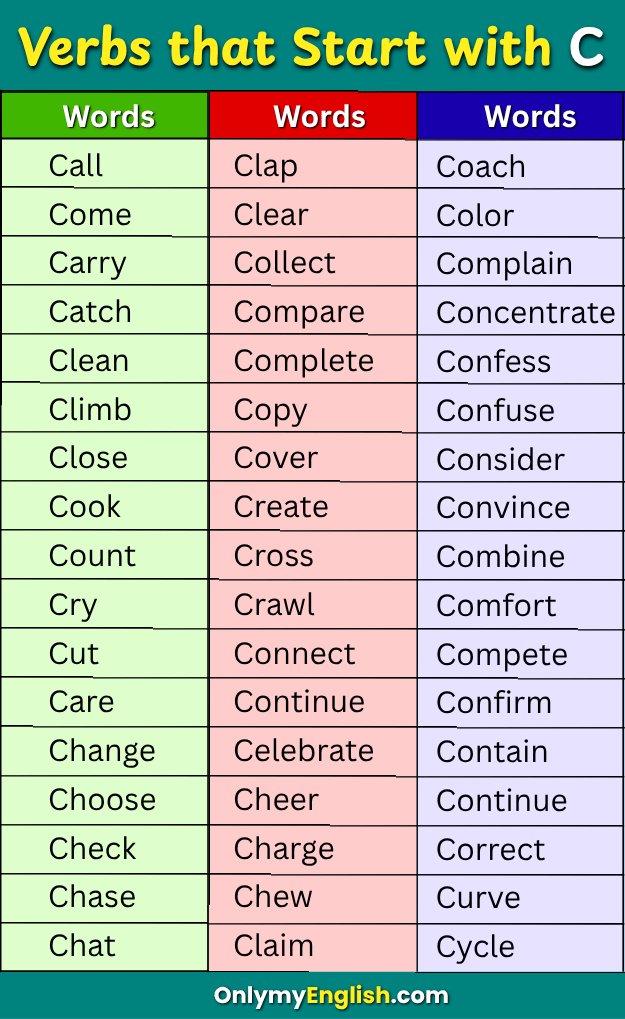
50 Common Verbs That Start with C
Here is a list of 50 common verbs that begin with C. Each verb has a simple meaning and an example sentence.
| Sr No | Verbs | Meaning | Example |
| 1 | Come | To move toward someone | Come here, please. |
| 2 | Color | To add color | I color the picture. |
| 3 | Collect | To bring things together | I collect stamps. |
| 4 | Cheer | To show support | We cheer for our team. |
| 5 | Call | To speak to someone | I call my friend. |
| 6 | Collapse | To fall down suddenly | The old chair may collapse. |
| 7 | Continue | To keep doing something | Continue your work. |
| 8 | Choke | To have trouble breathing | Food can make someone choke. |
| 9 | Cook | To prepare food | I cook rice. |
| 10 | Confuse | To make someone unsure | These words confuse me. |
| 11 | Chase | To follow someone quickly | The boy chases the ball. |
| 12 | Chat | To talk casually | I chat with my friend. |
| 13 | Catch | To grab something moving | Catch the ball. |
| 14 | Communicate | To share information | We communicate by phone. |
| 15 | Cover | To put something over another thing | Cover the food. |
| 16 | Chew | To bite food repeatedly | Chew your food well. |
| 17 | Count | To say numbers in order | I count the stars. |
| 18 | Consider | To think about something | Consider my idea. |
| 19 | Challenge | To test someone’s ability | This game challenges me. |
| 20 | Close | To shut something | Close the door. |
| 21 | Confess | To admit something | He confesses his mistake. |
| 22 | Charge | To ask for a price | They charge ten dollars. |
| 23 | Chase | To run after someone | The dog chases the cat. |
| 24 | Check | To look for mistakes | Check your answer. |
| 25 | Crawl | To move on hands and knees | The baby can crawl. |
| 26 | Change | To make something different | I change my clothes. |
| 27 | Clean | To remove dirt | I clean my room. |
| 28 | Complain | To say something is wrong | He complains about the noise. |
| 29 | Connect | To join things together | Connect the two wires. |
| 30 | Clap | To hit your hands together | We clap for the singer. |
| 31 | Cry | To shed tears | The baby may cry. |
| 32 | Convince | To make someone believe something | I convince him to try again. |
| 33 | Climb | To go up | We climb the hill. |
| 34 | Concentrate | To give full attention | Concentrate on your work. |
| 35 | Complete | To finish something | I complete my homework. |
| 36 | Care | To look after someone | I care for my dog. |
| 37 | Copy | To write or make the same thing | Copy this sentence. |
| 38 | Claim | To say something belongs to you or is true | He claims the bag is his. |
| 39 | Clear | To remove things | Clear the table. |
| 40 | Compare | To find similarities or differences | Compare the two pictures. |
| 41 | Cling | To hold tightly | The child clings to her mother. |
| 42 | Choose | To pick one thing | Choose a book. |
| 43 | Cut | To divide with a sharp tool | Cut the paper. |
| 44 | Create | To make something new | I create a drawing. |
| 45 | Coach | To train someone | She coaches the team. |
| 46 | Carry | To take something | I carry a bag. |
| 47 | Command | To give an order | The officer commands the team. |
| 48 | Celebrate | To enjoy a special day | We celebrate my birthday. |
| 49 | Crush | To press until broken | Crush the paper. |
| 50 | Cross | To go from one side to another | Cross the road carefully. |
Everyday Action C Verbs
These verbs describe simple actions we do at home, at work, or in daily life.
- Cancel – Cancel the plan. They cancel the match due to rain.
- Cross – Cross the road carefully. He crosses the bridge.
- Calculate – Calculate the total. She calculates the cost.
- Clap – Clap your hands. The crowd claps loudly.
- Celebrate – Celebrate your birthday. We celebrate the festival.
- Clasp – Clasp the necklace. She clasps her hands.
- Chop – Chop the onions. He chops wood for the fire.
- Cough – He coughs at night. She coughs in the cold.
- Chat – Chat with friends. They chat for hours.
- Clutch – Clutch the bag tightly. He clutches the railing.
- Chew – Chew your food well. The dog chews a bone.
- Connect – Connect the wires. He connects the phone to the charger.
- Crawl – The baby crawls. The lizard crawls on the wall.
- Comb – Comb your hair. She combs her daughter’s hair.
- Catch – Catch the ball. He catches a cold in winter.
C Verbs for Thinking and Feeling
Some C verbs are about the mind and the heart. They show what we think, feel, or want.
- Care – I care about you. She cares for the poor.
- Calculate – He calculates the risk. She calculates her next move.
- Concern – This concerns you. The news concerns me.
- Cherish – Cherish good memories. She cherishes her family.
- Confess – Confess your mistake. He confesses the truth.
- Comfort – Comfort the child. He comforts his friend.
- Choose – Choose wisely. He chooses to stay calm.
- Consider – Consider the offer. She considers all options.
- Claim – He claims the prize. She claims it is true.
- Crave – I crave sweets. She craves attention.
- Convince – Convince the buyer. He convinces her to join.
- Challenge – Challenge yourself. He challenges the idea.
C Verbs for Communication
We use these verbs when we talk, write, or share ideas.
- Chat – Chat with me. They chat online daily.
- Call – Call me tonight. She calls her boss.
- Consult – Consult a doctor. She consults her teacher.
- Complain – Do not complain. He complains about the food.
- Converse – Converse politely. They converse in English.
- Congratulate – Congratulate the winner. We congratulate the team.
- Conclude – Conclude the speech. She concludes the meeting.
- Criticize – Do not criticize others. He criticizes the plan.
- Confirm – Confirm the date. He confirms the booking.
- Claim – He claims to know. She claims the money.
C Verbs for Work and Making
These verbs are useful at work, in school, and in the kitchen.
- Carve – Carve the wood. He carves a statue.
- Cancel – Cancel the order. They cancel the meeting.
- Collect – Collect the fees. She collects stamps.
- Check – Check the stock. She checks the reports.
- Compile – Compile the data. He compiles the list.
- Coach – Coach the team. He coaches young players.
- Circulate – Circulate the notice. Air circulates in the room.
- Compose – Compose a song. She composes emails fast.
- Classify – Classify the files. She classifies the plants.
- Cement – Cement the bricks. They cement the wall.
C Verbs with a Little More Challenge
These verbs are a bit harder. But they are still useful. Learn them slowly.
- Capture – Capture the moment. Police capture the thief.
- Console – Console the sad child. He consoles his friend.
- Coincide – The dates coincide. Their ideas coincide.
- Criticize – Do not criticize. He criticizes the plan.
- Clarify – Clarify the point. She clarifies the doubt.
- Crack – Crack the code. The cup cracks in hot water.
- Captivate – The song captivates us. Her smile captivates him.
- Consist – The team consists of five players. The box consists of tools.
- Conceal – Conceal the truth. She conceals her feelings.
- Congratulate – Congratulate the winner. We congratulate her.
- Challenge – Challenge the rules. He challenges himself daily.
- Contribute – Contribute to the fund. She contributes ideas.
- Condemn – Condemn bad actions. They condemn the attack.
- Cling – Cling to hope. The child clings to her mother.
- Crawl – The baby crawls. Traffic crawls at noon.
- Cease – Cease the noise. The rain ceases at last.
- Consult – Consult the expert. She consults her parents.
- Commit – Commit to your goal. He commits a small mistake.
- Curve – The road curves left. She curves the paper.
- Confuse – Do not confuse me. The map confuses him.
- Chant – Chant the mantra. The crowd chants slogans.
- Control – Control your anger. He controls the machine.
- Conduct – Conduct the meeting. She conducts the test.
- Certify – Certify the document. They certify the goods.
- Continue – Continue your work. The rain continues all day.
- Confess – Confess your fault. He confesses the truth.
- Cleanse – Cleanse your face. The rain cleanses the air.
- Crash – The car crashes. The waves crash on the rocks.
- Clash – The teams clash today. Their views clash often.
- Craft – Craft a story. She crafts beautiful pots.
- Complain – Complain politely. He complains about the noise.
- Circulate – Circulate the news. Blood circulates in the body.
- Coordinate – Coordinate the plan. She coordinates the event.
- Cede – Cede the land. They cede the point.
- Consume – Consume less sugar. The fire consumes the wood.
- Comply – Comply with the rules. He complies with the order.
- Clog – Hair clogs the drain. Traffic clogs the road.
- Create – Create art. She creates new ideas.
- Charge – Charge the phone. They charge a fee.
- Convey – Convey the message. Words convey feelings.
- Celebrate – Celebrate the win. We celebrate small joys.
- Contain – The box contains books. The bag contains fruit.
- Combine – Combine the teams. She combines work and rest.
- Cultivate – Cultivate good habits. Farmers cultivate the land.
- Chide – Do not chide the child. She chides him softly.
- Cooperate – Cooperate with others. They cooperate on the project.
- Commend – Commend good work. The teacher commends her.
- Cure – Cure the illness. Rest cures a cold.
- Conquer – Conquer your fear. They conquer the peak.
- Coax – Coax the child to eat. He coaxes the dog out.
- Credit – Credit the writer. They credit the success to teamwork.
- Collapse – The old wall collapses. He collapses from tiredness.
- Crush – Crush the ice. The crowd crushes forward.
- Conserve – Conserve water. We conserve energy.
- Cite – Cite the source. He cites a famous book.
- Correct – Correct the errors. He corrects the copy.
- Charm – Charm the guests. Her voice charms everyone.
- Convince – Convince the buyer. He convinces the team.
- Communicate – Communicate clearly. They communicate by email.
- Consider – Consider the offer. She considers all sides.
- Caution – Caution the driver. He cautions the students.
- Construct – Construct a road. They construct new homes.
- Concentrate – Concentrate on your work. He concentrates in class.
- Complete – Complete the task. She completes her homework.
- Compete – Compete with yourself. Teams compete for the cup.
Practice Time
Pick ten C verbs from this post. Write one short sentence for each. Say them out loud. Then ask a friend to check your sentences. Do this every day for one week. You will see a big change in your English.
Verbs that start with C are useful for everyday English. Words such as call, carry, catch, clean, climb, close, cook, and count are easy to learn.
Keep learning and keep practicing!
You May Also Like