Verbs starting with “K” are essential for English learners. Common action verbs include “keep,” “know,” and “kick.” For example, “She keeps a diary every night.” Positive verbs like “kindle” and “kiss” express good feelings. You can say, “He kisses his mother goodbye each morning.”
Different types of “K” verbs are also useful. “Knock” and “kneel” are common verbs, as in “Someone knocks on the door” and “They kneel during prayer.” “Knit” and “knead” are action verbs, like “Grandma knits a warm scarf.” Practice these verbs daily to build your confidence. Try using “kidnap,” “knead,” and “knight” in your own sentences.
Verbs Beginning With “K” and along their Meaning
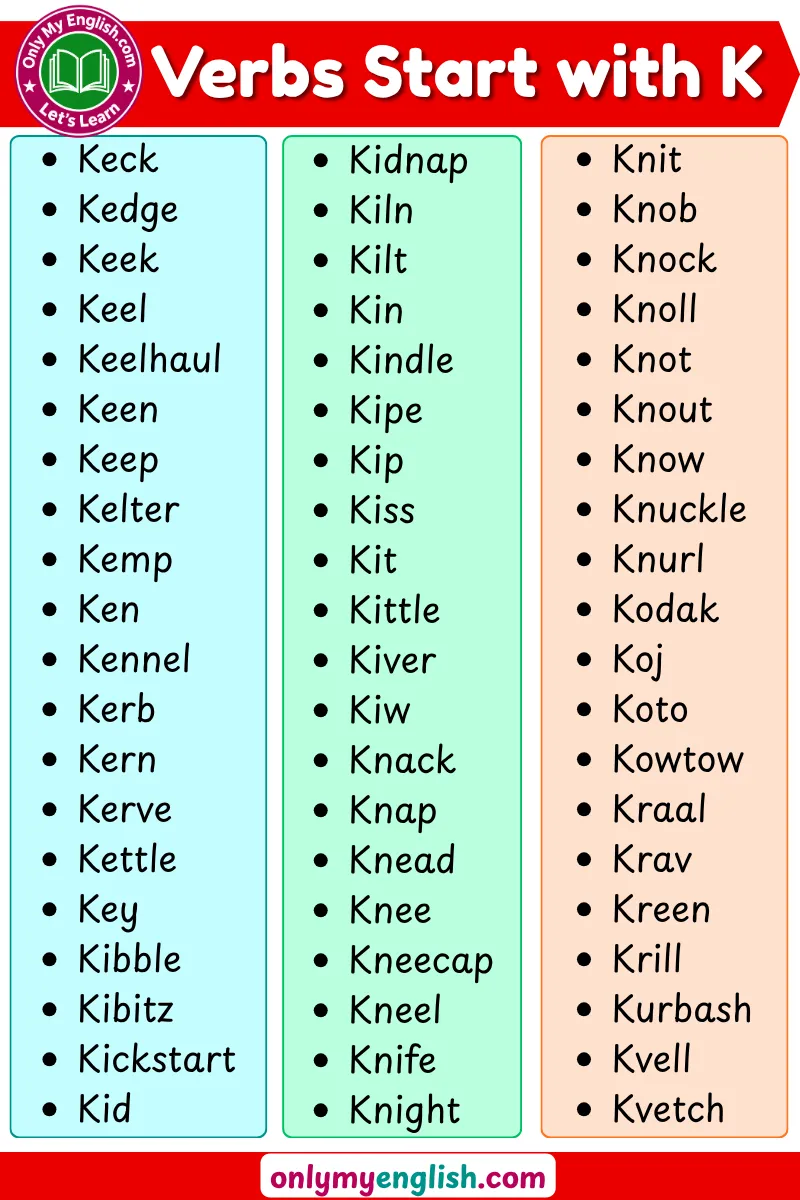
Below is a complete list of all verbs beginning with “K,” along with their meanings.
Verbs start with Ka
- Keel – Turn over; capsize (of a ship)
- Keelhaul – Drag under a ship as punishment; reprimand severely
- Keen – Wail in grief; sharpen
- Keep – Hold or maintain possession of
- Kennel – Shelter or confine in a kennel
- Kerb – Restrain or control (British spelling of curb)
- Kernel – Form into a kernel or core
- Ketch – Catch (archaic or nautical)
- Key – Enter data; fasten with a key
- Kibitz – Chat or joke; give unwanted advice
- Kickstart – Start an engine or process forcefully
- Kid – Joke or tease; deceive playfully
- Kiddle – Set a fish trap (dialect)
- Kidnap – Take someone away illegally by force
- Kiln – Bake or dry in a kiln
- Kilter – Put in good order (usually “out of kilter”)
- Kindle – Start a fire; arouse emotion or interest
- Kindred – Be related or similar (rare)
- Kip – Sleep (British informal)
- Kiss – Touch with the lips affectionately
- Kit – Equip with necessary items
- Kittle – Ticklish or difficult to handle (Scottish)
- Kibble – Grind into coarse meal
Verbs start with Ke
- Keck – Feel disgust; retch
- Kedge – Move a ship by hauling on an anchor
- Keek – Peep or look quickly (Scottish)
- Keep – Continue or maintain
- Kelter – Be in good order (archaic)
- Kemp – Compete or strive (archaic)
- Ken – Know or perceive (Scottish)
- Kennel – Shelter in a kennel
- Kerb – Check or restrain
- Kern – Form into grains; thicken
- Kerve – Carve or cut (dialect)
- Kettle – Boil or cook in a kettle
- Key – Adjust or regulate
- Keystone – Support as a keystone (rare)
Verbs start with Ki
- Kibble – Crush into small pieces
- Kick – Strike with the foot
- Kid – Joke or deceive playfully
- Kidnap – Abduct someone
- Kill – Cause death; put an end to
- Kilt – Pleat or tuck up (Scottish)
- Kindle – Ignite; inspire
- Kin – Be related to (rare)
- Kipe – Steal or pilfer (dialect)
- Kiss – Caress with the lips
- Kit – Supply with equipment
- Kittle – Tickle; puzzle
- Kiver – Cover (dialect)
- Kiw – Peep or glance (dialect)
Verbs start with Kn
- Knack – Acquire skill (rare usage)
- Knap – Break or chip stone
- Knead – Work dough or clay with the hands
- Knee – Strike or push with the knee
- Kneel – Rest on the knees
- Knife – Cut or stab with a knife
- Knight – Invest with knighthood
- Knit – Make fabric by interlocking yarn
- Knob – Provide with a knob; polish (dialect)
- Knock – Strike a surface to make a noise
- Knoll – Ring a bell (archaic)
- Knot – Tie in a knot; entangle
- Knout – Flog with a knout
- Know – Have knowledge or awareness
- Knuckle – Press or rub with the knuckles
- Knurl – Make knobby or ridged
Verbs start with Ko
- Kodak – Take a photograph (trademark, informal)
- Koj – Joke (rare or dialect)
- Koto – Play the koto (Japanese instrument)
- Kowtow – Act submissively; bow deeply
Verbs start with Kr
- Kraal – Enclose in a kraal (South African)
- Krav – Demand (rare)
- Kreen – Shrink or shrivel (dialect)
- Krill – Fish for krill (rare)
Verbs start with Ku
- Kurbash – Flog with a whip (North African)
- Kvell – Feel or express pride (Yiddish)
- Kvetch – Complain persistently (Yiddish)
Verbs start with Ky
- Kyanize – Treat wood to prevent decay
- Kybosh – Put an end to; stop (informal)
Common Verbs beginning with K
Here is the shortened list of common verbs starting with “K”
- Keep – Hold or maintain possession
- Kick – Strike with the foot
- Kid – Joke or tease
- Kill – Cause death
- Kiss – Touch with the lips
- Knead – Work dough with the hands
- Kneel – Rest on the knees
- Knit – Make fabric from yarn
- Knock – Strike a surface
- Knot – Tie in a knot
- Know – Have knowledge
- Kidnap – Abduct someone
- Kindle – Start a fire; inspire
- Kit – Equip with supplies
- Knife – Cut with a knife
- Knight – Confer knighthood on
Action Verbs Starting with K
Here is the shortened list of action verbs starting with “K”.
- Kick – Strike with the foot
- Kidnap – Take away illegally
- Kill – Cause death
- Kindle – Start a fire
- Kiss – Touch with the lips
- Knead – Press and shape dough
- Kneel – Go down on the knees
- Knife – Cut or stab
- Knit – Interlock yarn
- Knock – Hit a surface
- Knot – Fasten with a knot
- Know – Understand or perceive
- Kowtow – Bow deeply
- Kvell – Express pride
- Kvetch – Complain
- Keelhaul – Drag under a ship
- Kickstart – Start forcefully
- Kybosh – Put an end to
Phrasal Verbs that Start with K
Here is a list of phrasal verbs that start with “K”
- Keep at – Persist in doing something
- Keep away – Stay at a distance
- Keep back – Hold back; withhold
- Keep down – Repress or stay low
- Keep from – Prevent from doing something
- Keep in – Confine; stay indoors
- Keep off – Avoid or stay away from
- Keep on – Continue doing something
- Keep out – Not enter; exclude
- Keep to – Stay within limits; adhere to
- Keep up – Maintain pace; continue
- Kick around – Discuss informally; treat badly
- Kick back – Relax; return a portion
- Kick in – Start working; contribute money
- Kick off – Begin an event
- Kick out – Expel someone
- Kick up – Cause trouble; raise dust
- Knock about – Wander; treat roughly
- Knock around – Travel casually; discuss informally
- Knock back – Drink quickly; reject
- Knock down – Strike to the ground; demolish
- Knock off – Stop work; reduce price; steal (informal)
- Knock out – Make unconscious; defeat
- Knock over – Cause to fall
- Knock together – Assemble hastily
- Knock up – Awaken (British); make pregnant (informal)
- Know of – Be aware of someone or something
- Know about – Have information concerning
Conclusion
Mastering verbs that start with “K” will expand your vocabulary and make your English more expressive. Practice these verbs daily by using them in your own sentences to build confidence and fluency. From common everyday verbs like “keep” and “know” to more specialized terms like “keelhaul” and “kvetch,” the letter “K” offers a rich variety of verbs for every situation.