
Word pairs are one of the most fascinating yet overlooked aspects of English vocabulary. These are fixed combinations of two words that naturally belong together in a specific order—expressions like “rock and roll,” “sick and tired,” or “now and then.”
Native speakers use them instinctively without thinking, but for English learners, they represent both a challenge and an opportunity.
In this article, I’ll explore word pairs from my own knowledge and perspective, going beyond simple lists to explain why these expressions work the way they do and how you can master them effectively.
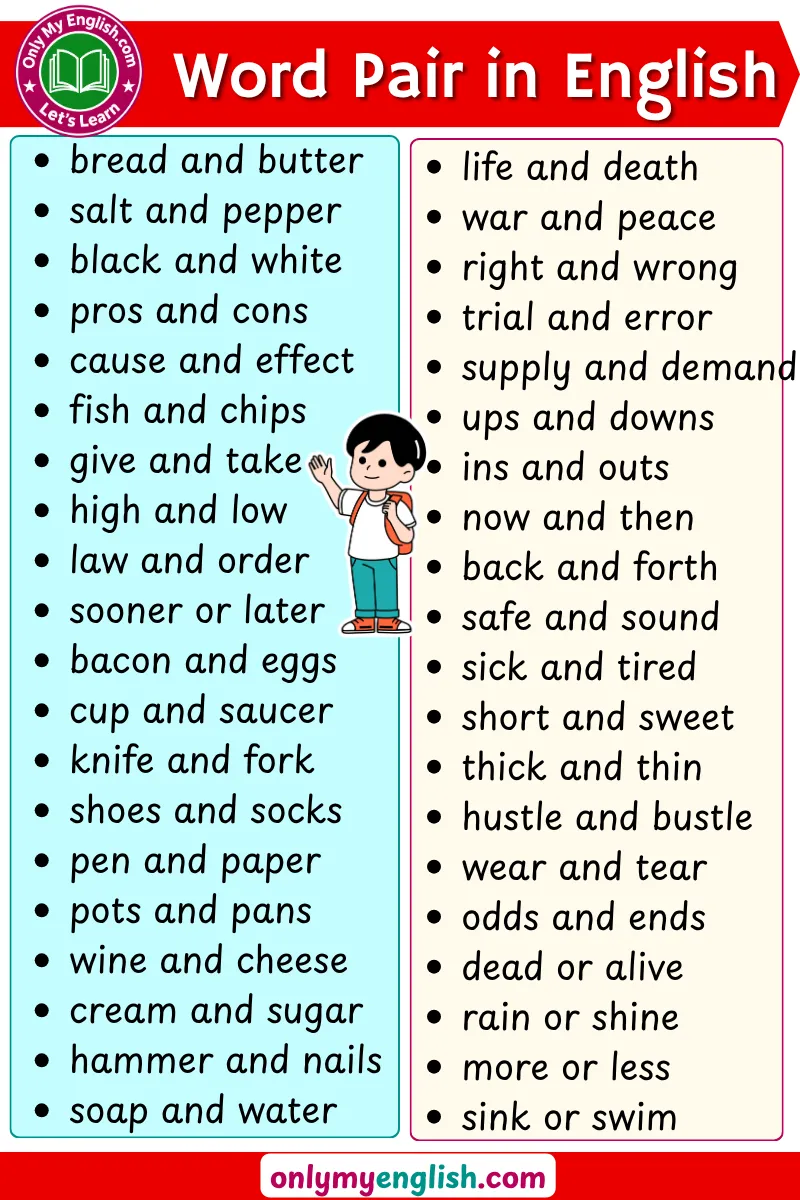
What Exactly Are Word Pairs?
Word pairs go by several technical names in linguistics:
- Binomials – two words joined by “and” or “or” (e.g., “law and order”)
- Irreversible binomials – pairs that cannot be reversed (e.g., “bread and butter,” not “butter and bread”)
- Freezes – fixed expressions where the order is frozen
- Collocations – words that habitually appear together
The key characteristic is fixed order. You cannot swap the words without sounding strange to a native ear. “Salt and pepper” sounds right; “pepper and salt” sounds wrong—even though both words are correct individually.
The Hidden Rules Behind Word Order
Why do we say “black and white” but not “white and black”? Linguists have identified several principles that govern word pair order:
1. The Rhythm Rule
English speakers prefer a certain rhythmic flow. Words with fewer syllables or shorter sounds often come first:
- short and sweet (not “sweet and short”)
- thick and thin (not “thin and thick”)
- high and low (not “low and high”)
2. The Vowel Order Rule
There’s a subtle pattern where words with vowels pronounced further forward in the mouth tend to come first:
- this and that (i before a)
- flip and flop (i before o)
- tip and top (i before o)
3. The Meaning Rule
When there’s a logical progression, the natural order follows it:
- cause and effect (cause comes before effect)
- crime and punishment (crime precedes punishment)
- question and answer (question comes first)
- read and write (reading typically precedes writing)
4. The “Me First” Rule
English speakers tend to put themselves or the more familiar/important concept first:
- here and there (here = closer to speaker)
- now and then (now = present moment)
- man and wife (traditional ordering)
5. The Positive-First Rule
Positive or neutral words often precede negative ones:
- alive and well (positive)
- pros and cons (pros = positive first)
- right and wrong (right = positive first)
- win or lose (win = positive first)
6. The Male-First Rule (Traditional)
Historically, English placed male terms first, though this is changing:
- husband and wife
- brother and sister
- boys and girls
- Adam and Eve
Modern usage increasingly challenges these, and many style guides now recommend gender-neutral alternatives where possible.
Types of Word Pairs
1. Reversible vs. Irreversible
Irreversible pairs are fixed and cannot be swapped:
- bread and butter ✅ / butter and bread ❌
- salt and pepper ✅ / pepper and salt ❌
- fish and chips ✅ / chips and fish ❌
Reversible pairs allow either order without changing meaning (though one may sound more common):
- more or less / less or more (both used)
- now and then / then and now (different meanings!)
- before and after / after and before (both possible)
2. “And” Pairs vs. “Or” Pairs
Most word pairs use “and,” but some use “or” to express alternatives:
- dead or alive
- rain or shine
- sooner or later
- more or less
- all or nothing
- sink or swim
3. Alliterative Pairs
Some pairs share sounds, making them memorable:
- safe and sound (s-s)
- prim and proper (p-p)
- hale and hearty (h-h)
- sick and tired (s-t)
- thick and thin (th-th)
4. Rhyming Pairs
Some pairs rhyme or have internal rhyme:
- wear and tear
- odds and sods
- hustle and bustle
- nitty-gritty
- willy-nilly
- higgledy-piggledy
Thematic Categories
From my own knowledge, word pairs fall into several useful categories:
Food and Drink
- bread and butter
- fish and chips
- salt and pepper
- bacon and eggs
- ham and eggs
- cream and sugar
- wine and cheese
- cookies and milk
- peanut butter and jelly
- macaroni and cheese
- pork and beans
- sweet and sour
- tea and biscuits
Relationships and People
- husband and wife
- bride and groom
- mother and father
- brother and sister
- boys and girls
- ladies and gentlemen
- Adam and Eve
- Bonnie and Clyde
- Romeo and Juliet
- Tom and Jerry
Everyday Objects and Actions
- knife and fork
- cup and saucer
- shoes and socks
- shirt and tie
- pen and paper
- lock and key
- needle and thread
- hammer and nails
- pots and pans
- soap and water
- bucket and spade
Abstract Concepts
- life and death
- war and peace
- love and hate
- right and wrong
- good and evil
- cause and effect
- crime and punishment
- law and order
- supply and demand
- trial and error
- give and take
- ups and downs
- pros and cons
- strengths and weaknesses
- ins and outs
Time and Movement
- now and then
- sooner or later
- back and forth
- up and down
- in and out
- to and fro
- here and there
- rise and fall
- ebb and flow
- coming and going
Descriptive Pairs
- black and white
- short and sweet
- nice and easy
- prim and proper
- pure and simple
- tall and thin
- thick and thin
- safe and sound
- hale and hearty
- null and void
- signed and sealed
Idiomatic Pairs
- high and dry (abandoned)
- down and out (destitute)
- touch and go (uncertain)
- hot and bothered (agitated)
- huffing and puffing (exhausted)
- hemmed and hawed (hesitated)
- tossed and turned (restless)
- ranting and raving (angry)
- forgive and forget (move on)
- wait and see (be patient)
Why Word Pairs Matter
For Fluency
Using word pairs correctly is a mark of fluency. When you say “rock and roll” instead of “roll and rock,” native speakers immediately know English is your first language—or that you’ve learned it very well.
For Natural Rhythm
Word pairs give English its characteristic rhythm. “Bits and pieces” flows better than “pieces and bits.” Learning these expressions trains your ear for natural English cadence.
For Vocabulary Building
Each word pair teaches you two words in a memorable context. “Hale and hearty” teaches you both “hale” (healthy) and “hearty” (robust)—words you might not encounter otherwise.
Common Mistakes and How to Avoid Them
Mistake 1: Reversing the Order
❌ “I need pepper and salt.” → ✅ “I need salt and pepper.”
Solution: Learn pairs as complete units, not as individual words.
Mistake 2: Using the Wrong Conjunction
❌ “dead and alive” → ✅ “dead or alive”
❌ “rain and shine” → ✅ “rain or shine”
Solution: Pay attention to whether a pair expresses combination (and) or alternative (or).
Mistake 3: Mixing Up Similar Pairs
❌ “We discussed the cons and pros.” → ✅ “We discussed the pros and cons.”
Solution: Practice pairs in context, not isolation.
Mistake 4: Overusing Pairs in Formal Writing
Some pairs are conversational and sound out of place in academic writing:
- “nice and easy” (informal)
- “fun and games” (informal)


